

Claude Code for the rest of us.

Claude Code is doing to software what the spreadsheet did to financial modeling in the 1980s — turning a specialist skill into a general literacy.

Scroll to see the argument
~/my-club-site — claude
>
  • my-club-site/
  •   └─ index.html ✓ ready to open

01

We've watched this movie before.

Before 1979, modeling a company's cash flow, running a sensitivity analysis, or asking "what if we raised prices 8%?" required a trained financial analyst with a ledger pad, a calculator, and hours to redo every dependent number by hand. Spreadsheets were a specialist's tool because arithmetic-at-scale was a specialist's problem.

Then VisiCalc shipped in 1979, and Lotus 1-2-3 in 1983. Suddenly a small-business owner, a teacher, a nonprofit director could build their own budget, model their own scenarios, ask their own "what if." The underlying math stayed exactly as hard. What changed was the interface — and who got to use it.

Software is running the same play. In 2023, building a working web app required knowing a programming language, a framework, a terminal, a deployment pipeline — a stack of specialist knowledge with a steep floor. By 2026, tools like Claude Code let someone who has never written a line of code describe what they want in plain English and get back something real, working, and deployed. The code is exactly as complicated as it's always been. The barrier to touching it just moved.

1979 – 1983 The analyst

  • Tool: ledger paper, calculator, then VisiCalc / Lotus 1-2-3
  • Who could model finances: trained analysts and accountants
  • To ask "what if," you recalculated every dependent cell by hand
  • Spreadsheets moved that power onto an office desk

2023 – 2026 The non-engineer

  • Tool: a terminal, then Claude Code
  • Who could build software: trained engineers with years of setup
  • To ship an idea, you needed a language, a framework, a deploy pipeline
  • Claude Code moves that power onto a laptop, no CS degree required

02

Chat gives you answers. Claude Code takes actions.

A chatbot like ChatGPT hands you a block of code and wishes you luck — you still have to create the files, install the tools, run it, and untangle whatever breaks. Claude Code instead works directly inside your project: it reads your files, writes them, runs your code, watches what breaks, and fixes it — in a loop, on your machine, until it works. Try the same request in both, below.

Chatbot chat-only.session

Press ▶ Run the request to see what a chatbot gives you back.

Agent ~/my-club-site — claude

Press ▶ Run the request to see Claude Code work through it step by step.

You keep specification authority — deciding what and why. The agent handles execution — the how.

03

Two builds I shipped as a non-engineer.

These are production sites serving a real organization, built by someone who cannot write the code by hand.

welandportal.org
Weland Portal sign-in screen
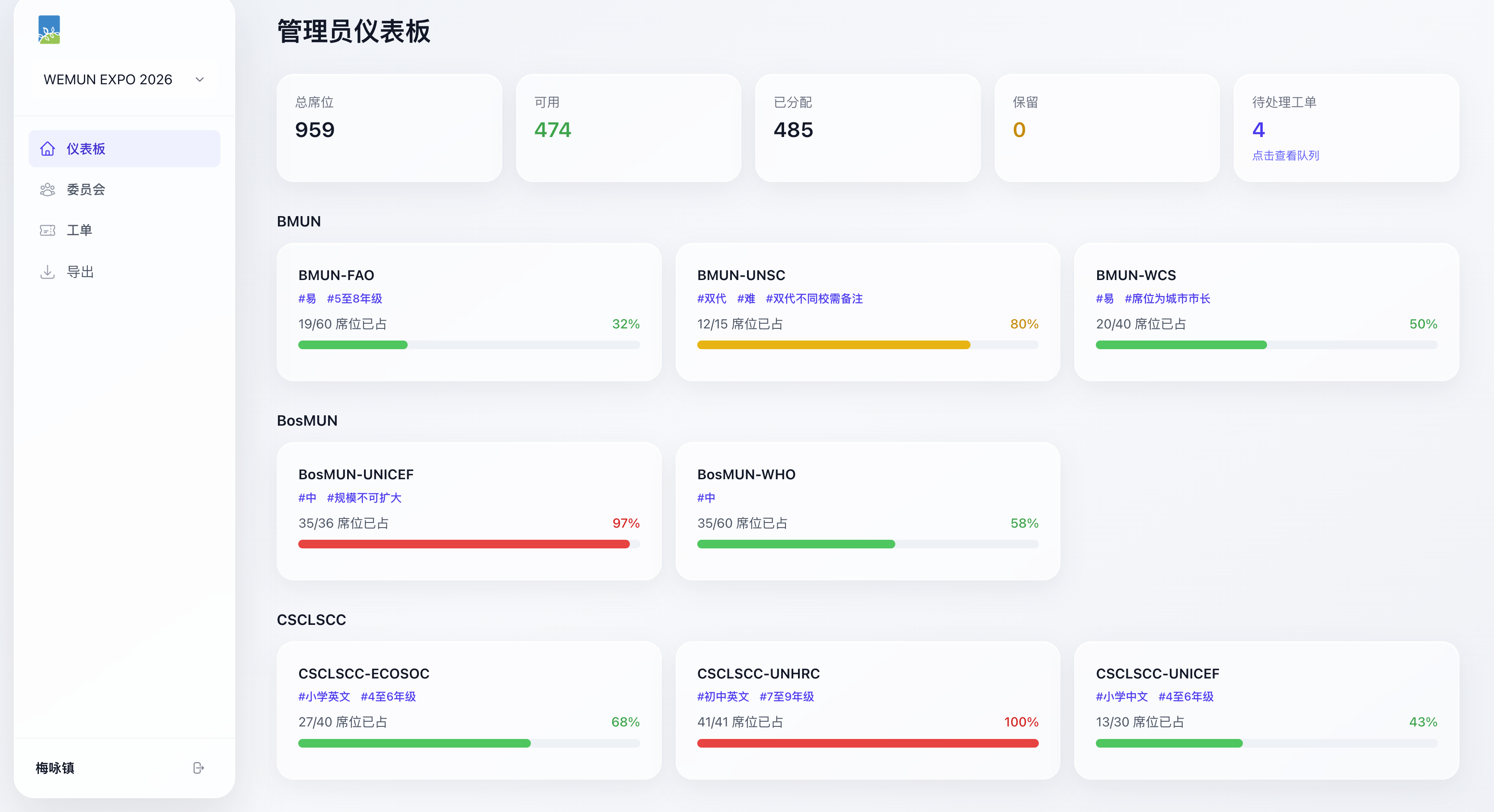
Weland Portal admin dashboard showing live seat-fill rates across committees
Weland Portal ticket queue with pending seat requests
sign-in

Weland Portal

welandportal.org
What it is
A seat allocation portal for Weland's Model UN conferences. It replaces an email-and-spreadsheet workflow with one system: sales reps submit seat requests per school, an admin reviews and assigns them, and everyone sees live status instead of chasing updates.
Who it's for
Weland's conference admin (me) and up to ten sales reps requesting seats across ~9 committees and several hundred total seats per conference.
What I asked Claude Code for
A portal where reps request seats by committee and school, I review and assign them myself, and everyone can see allocation progress without another email thread.
thepparty.party
Open the live site preview

The P Party

thepparty.party
What it is
A single-page event site for The P Party (April 25, 2026) — a live countdown, dress-code and vibe sections, a collaborative Spotify playlist embed, and a registration form, all built as one dark, terminal-flavored HTML page.
Who it's for
University of Tokyo PEAK students, USTEP exchange students, PEAK alumni, and their plus-ones registering to attend.
What I asked Claude Code for
An event page with a countdown to the party, sections covering the dress code and the vibe, an embedded playlist people could contribute to, and a registration form — in a dark, retro-terminal aesthetic.

04

How to think in Claude Code patterns.

Four habits separate someone who gets stuck from someone who ships.

Describe outcomes

Say what should happen for the visitor. Let Claude Code work out the implementation.

"Visitors should be able to RSVP."

Scope in layers

Get the skeleton working, then iterate. Never specify everything upfront.

Get the RSVP button working first. Add email confirmation later.

Treat errors as conversation

An error is just information for your next prompt.

Paste the red error text and ask: "what does this mean?"

You are the editor

Your judgment about what's good is the scarce input here.

Your taste decides what "done" looks like.

05

Build your own micro-tool.

Answer five short questions, about 10 minutes total. The panel on the right assembles a complete, copy-pasteable Claude Code prompt as you go — one you can actually run later.

1 Describe a small tool you wish existed
2 Who uses it, and on what device?
3 The single thing a user does on it
4 One thing it deliberately will not do
5 Pick a vibe, and a site you admire
A site you admire (optional)
Your prompt, assembled live
Copied ✓

Runs fine on the free Claude.ai / Claude Code tier. New to this? Start with the quickstart docs.

06

What this actually changes.

This is fundamentally a story about where judgment sits. Claude Code works because the human keeps specification authority — deciding what should exist, for whom, and why it matters — while delegating execution — the syntax, the file structure, the debugging loop — to the agent. That division is the whole idea: you tell it what to build, and it works out how.

That raises a real access question, and it cuts both ways. On one hand, tools like this widen opportunity: a club treasurer, a small nonprofit, a student with an idea and no CS background can now ship something real instead of waiting for someone else's roadmap. On the other hand, the same shift can narrow opportunity for people who spent years investing in the specialist skill of writing code by hand — the floor that used to guarantee their value is dropping. Both of these are true at the same time. A technology can democratize access and devalue expertise in the same motion, and pretending otherwise flattens what's actually happening.

One more thing worth sitting with: this page itself was built with Claude Code, by someone who cannot write the code by hand. The argument and the artifact are the same object.